The best document approval software for a small team does a few things very well. It routes a document to the right people in the right order and ties each approval to one specific version. It records who approved what and when, in a log you could hand to an auditor. It chases slow approvers so you don't have to. It should also be simple enough that an office manager can build a new workflow in an afternoon without calling IT. Enterprise features like custom scripting, complex forms engines and dedicated admins are usually overkill for a team of five to fifty people.
The only reliable way to know whether a tool fits is to test it with your own documents and your own people during a trial. This guide covers the features that matter, the ones you can safely skip, and a step-by-step test plan with a scorecard. Use it to compare two or three products in about two weeks.
What document approval software actually does
Document approval software replaces the email chain, the printed sign-off sheet and the question of who has the latest version. At its core it handles four jobs:
- Routing: sends a document to one or more reviewers, in sequence or at the same time.
- Decision capture: lets each reviewer approve, reject or request changes, with comments.
- Record keeping: stores the decision, the timestamp, the user and the exact version they saw.
- Follow-up: sends reminders, escalates overdue steps and notifies the requester when the process is done.
There are three types of tools that do this, and they often get confused:
- Standalone e-signature tools. These are built for getting signatures on finished documents, often from people outside your company. They are strong on signing and weaker on internal review, versioning and storage.
- Document management systems (DMS) with built-in workflows. The approval happens where the document already lives, so versions, permissions and audit logs come with it.
- General workflow or BPM platforms. These can automate almost anything, but they usually need more setup and someone who enjoys building logic.
For most small teams, the question is whether approvals happen next to the documents or in a separate tool. That choice decides how much copying, re-uploading and version confusion you live with.
Signs your team has outgrown email approvals
You probably need dedicated software if several of these sound familiar:
- Someone approved an older draft, and nobody noticed until later.
- You can't quickly prove who signed off on a contract, policy or invoice.
- Approvals stall because one person is traveling or on leave.
- Reviewers edit their own copies, and you merge changes by hand.
- The same approval process runs differently depending on who starts it.
- An auditor, client or certification body has asked for approval evidence, and finding it took hours.
What to look for: the must-haves
Workflow setup a non-technical person can manage
If only one person can change a workflow, that person becomes a bottleneck. Look for a visual or form-based builder where you pick steps, approvers and deadlines. Ask yourself whether your office manager could add a new step, such as legal review for contracts over a certain value, without help.
Sequential and parallel steps
Real processes mix both. A purchase request might go to the department head first and then to finance and operations at the same time. Check that the tool supports:
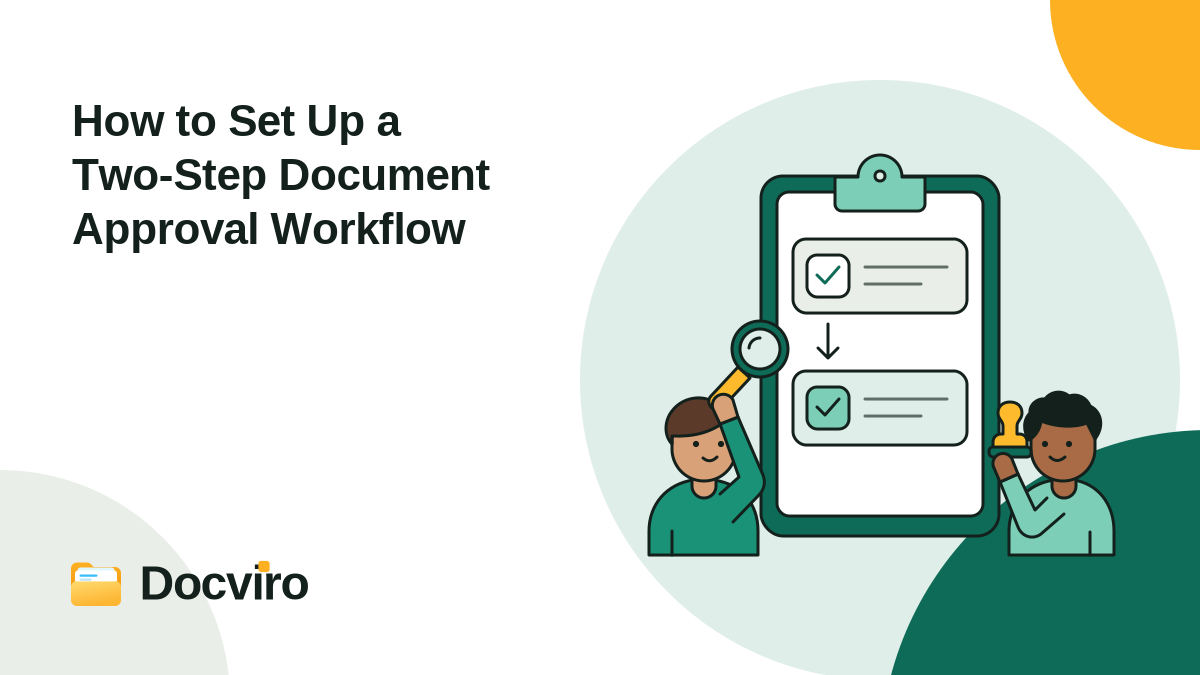
- Sequential steps, where step two starts only after step one is approved
- Parallel steps, where several people review at once
- Rules for parallel steps, such as all must approve versus any one can approve
- Approvers by role or group, not just by named person, so staff changes don't break workflows
Approvals tied to a specific version
This is the feature that separates real approval software from a shared folder with comments. When someone approves, the record should point to the exact version they reviewed. If the document changes afterward, the tool should make that obvious and ideally restart or flag the approval. Strong version history is the foundation here.
An audit trail you would show an auditor
Open the audit log during your trial and read it as if you were an outsider. It should show who did what, on which version, at what time, and with what comment. You should be able to filter by document or user and export the log. Users shouldn't be able to edit or delete entries.
Reminders, escalation and delegation
Most delays come from approvers who forgot, not from approvers who disagreed. Look for:
- Automatic reminders on a schedule you choose
- Due dates per step
- Escalation to a backup approver or manager when a step is overdue
- Delegation, so an approver can hand off tasks while out of office
Permissions and external participants
Approvers need access to the document without getting access to everything else. Check folder-level and document-level permissions. If clients, contractors or board members need to approve, find out how they take part. Do they need a paid seat, can they use a secure link, and do those links expire?
Signatures where they are actually needed
Many internal approvals don't need a formal signature. A logged approval from an authenticated user is usually enough evidence for policies, expense reports or marketing copy. Contracts, offer letters and client agreements often do need a signature. In that case it helps when signing is part of the same workflow rather than a separate export-and-upload step. Our guide to electronic signature laws in the US and EU explains when a simple e-signature is enough.
Notifications people will actually see
Email notifications with a direct link to the document are the minimum. Approving from a phone without hunting through menus matters more than most teams expect. Test it.
Nice-to-haves that pay off
These features aren't strictly required, but they save real time once approvals are running:
- AI summaries: a short summary helps a busy approver decide whether a twenty-page contract needs a close read or a quick skim. Treat it as a reading aid, not a substitute for review.
- Full-text search with OCR: being able to search scanned PDFs makes it easy to find past approvals and the documents behind them.
- Metadata extraction: pulling out fields like vendor, amount or contract date can feed routing rules and reporting.
- Retention rules: approved records often have to be kept for a set period, then disposed of on schedule.
- Templates: reusable workflows for recurring processes like invoices, policies or onboarding documents.
Comparing your options
| Approach | Good for | Weak spots | Typical setup effort |
|---|---|---|---|
| Email plus shared drive | Very occasional approvals | No reliable audit trail, version confusion, no reminders | None, but high ongoing effort |
| Standalone e-signature tool | Signing finished documents with outside parties | Limited internal review, documents stored separately | Low |
| DMS with built-in approval workflows | Recurring internal and external approvals tied to stored documents | Fewer custom logic options than BPM platforms | Low to moderate |
| General workflow or BPM platform | Complex, cross-system processes | Needs a dedicated builder, can be costly for small teams | Moderate to high |
If your approvals almost always involve documents you already store, a DMS with workflows avoids running two systems. For a broader feature checklist, see how to choose a document management system.
How to test document approval software in a trial
Demos show the happy path. Your test should show what happens on a messy Tuesday. Here is a plan that fits into a standard trial period.
Step 1: Pick three real workflows
Choose workflows that differ from each other, for example:
- A simple one: a policy update approved by one manager
- A multi-step one: a vendor invoice or purchase request with sequential and parallel steps
- An external one: a contract or proposal that needs a client signature
Step 2: Map them on paper first
Write down every step, every approver or role, the deadline, and what happens on rejection. This takes thirty minutes and shows you where your current process is vague. If you need a framework, our guide on creating approval workflows walks through it.
Step 3: Have the actual owner build them
Ask the person who will maintain workflows day to day to build all three without vendor help. Time it. Note every point where they got stuck or had to search the help docs.
Step 4: Run them with real people
Invite three to five colleagues, including at least one who is skeptical of new tools. Have them approve, reject and comment on their phones and laptops. Ask afterward whether anything was confusing.
Step 5: Try to break it
This is the most valuable part of the test. Try each of these:
- Edit the document after one approver has approved. Does the tool flag it?
- Reject at step two. Where does the document go, and is the reason recorded?
- Set an approver as out of office. Does delegation or escalation work?
- Remove a user from the company. What happens to their pending tasks?
- Let a step go overdue. Do reminders and escalation fire as configured?
- Send an external approval link, then let it expire. Can it still be opened?
Step 6: Pull the evidence
Pretend an auditor asked for proof that a specific contract was approved. Time how long it takes to find the record, the version and the signature details, and to export them.
Step 7: Check the exit
Confirm you can export documents, version history and audit logs in standard formats. You may never leave, but you should know you could.
A simple scorecard
Rate each tool from 1 to 5 on each line and weight what matters most to you.
| Criterion | What a 5 looks like |
|---|---|
| Setup time | Owner built all three workflows unaided in under a few hours |
| Version integrity | Edits after approval are clearly flagged or restart the workflow |
| Audit trail | Complete, uneditable, filterable and exportable |
| Reminders and escalation | Worked exactly as configured in your tests |
| Approver experience | Testers approved on mobile without instructions |
| External participants | Secure, expiring access without buying extra seats |
| Signatures | Signing happens inside the workflow with a verifiable record |
| Cost | Predictable at your current and next-year headcount |
Compliance points worth checking
You don't need to become a lawyer to buy approval software, but a few rules may apply:
- ESIGN Act and UETA (US): these give electronic signatures and records the same legal effect as paper in most transactions, with some exceptions such as wills and certain notices.
- eIDAS (EU): defines simple, advanced and qualified electronic signatures. A qualified signature has the legal effect of a handwritten one across the EU. Most business documents can use simple or advanced signatures, but check if a document type requires more.
- GDPR and CCPA: approval records often contain personal data. Ask where data is stored, whether the vendor signs a data processing agreement, and how deletion requests are handled.
- HIPAA: if documents include protected health information, the vendor must be willing to sign a business associate agreement.
- Quality and security standards: frameworks like ISO 9001 expect documents to be reviewed and approved before use, with evidence. A reliable audit trail makes that much easier.
How Docviro handles document approvals
Docviro builds approvals into the same place where documents are stored, so teams don't have to move files between tools. Here is what that includes:
- Approval workflows that route documents to reviewers and record each decision. You can set them up from the workflow automation feature.
- Version history on every document, so approvals can be traced back to the version that was reviewed.
- Audit logs that record user actions on documents for later review and export.
- Electronic signatures for documents that need them, with a certificate of completion and a public verification page so a recipient can confirm the signature record.
- Folder permissions and secure sharing with expiring links, which helps when external people need to review or sign.
- Full-text search with OCR, AI summaries and metadata extraction, so approvers can find and understand documents faster.
- Retention rules to keep approved records for as long as your policy requires.
As with any product, run the test plan above during a trial and check that the workflows behave the way your process needs.
FAQ
Is document approval software the same as e-signature software?
Not quite. E-signature software focuses on collecting signatures on finished documents, often from outside parties. Approval software handles internal review, routing, reminders and version tracking, and some tools include signing as one step. Many small teams need both, which is why combined tools are popular.
Does every approval need an electronic signature?
No. For many internal documents, a logged approval by an authenticated user with a timestamp is sufficient evidence. Formal signatures matter more for contracts, employment documents and agreements with clients or vendors. When in doubt, check the requirements for that document type or ask your legal advisor.
How long should a trial evaluation take?
For a small team, about two weeks is usually enough to build three workflows, run them with real users and test edge cases. Testing two or three tools side by side with the same workflows makes the comparison fair. Avoid deciding on a demo alone.
What is the most common mistake when choosing approval software?
Testing only the happy path. Most problems appear when someone rejects a document, edits it after approval, or goes on leave. Deliberately testing those situations during the trial tells you far more than a feature list does.
Can we keep using our shared drive alongside approval software?
You can, but it often recreates the version confusion you were trying to fix. If approvals happen in one tool and files live in another, people end up approving copies. Many teams move the documents that go through approvals into the same system first, then migrate the rest over time.