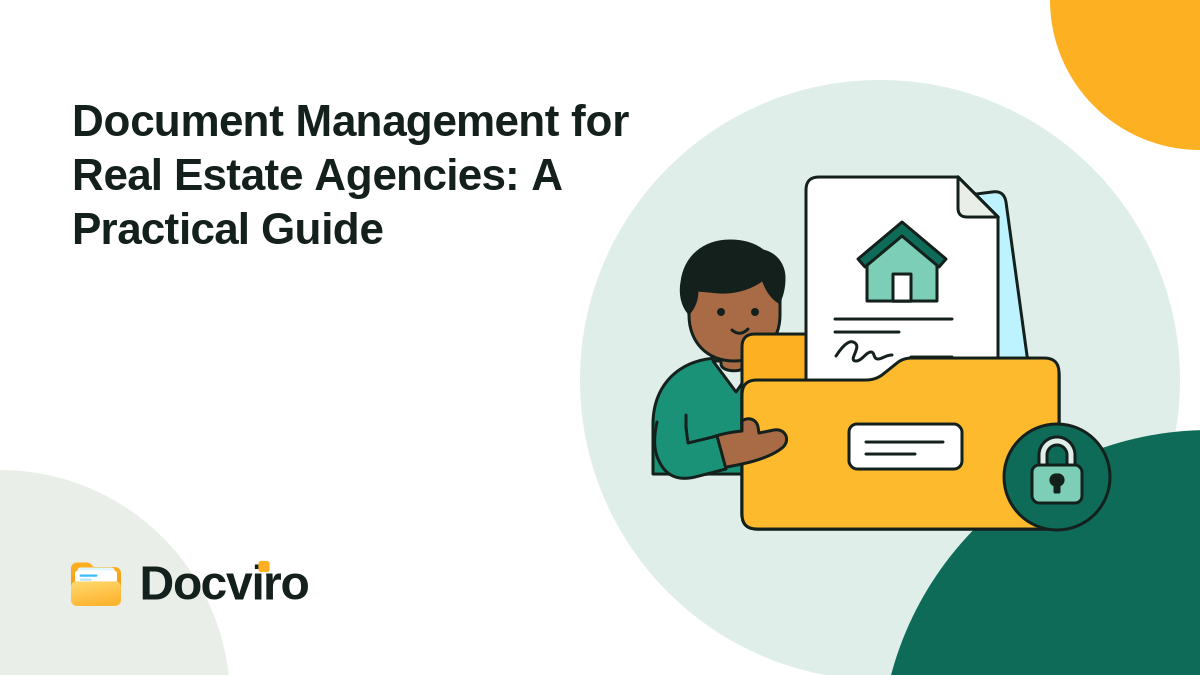
Document management for a real estate agency means keeping every listing, offer, disclosure and closing file in one organized, searchable place. The right people can find, sign and review each file, and it stays stored for as long as your license law requires. In practice, that comes down to five habits: a standard folder structure for every transaction, consistent naming and metadata, electronic signatures for the documents that allow them, a broker review step before a file closes, and retention rules that keep records as long as required and no longer.
Most agencies don't struggle because they lack software. They struggle because each agent runs files their own way. Offers live in email, disclosures sit on a phone, and signed contracts end up in a personal cloud drive. This guide shows how to fix that. It covers file structure, compliance review, e-signature rules in the US and EU, record retention, secure sharing and agent offboarding, and it ends with a simple rollout plan.
Why real estate paperwork is hard to manage
A single home sale can involve more documents and more outside parties than most small businesses handle in a month. Several factors make it messy:
- Many parties. Buyers, sellers, landlords, tenants, cooperating agents, lenders, title or escrow companies, notaries, inspectors and appraisers all send and receive documents.
- Many versions. Offers, counteroffers and addenda go back and forth, often within hours. Knowing which version was actually accepted matters.
- Hard deadlines. Inspection, financing and appraisal contingencies run on fixed dates. A missed deadline can cost a client the deal.
- Distributed agents. Agents are often independent contractors who work from their phones, cars and home offices, using whatever tools they already have.
- Broker responsibility. In the US, the supervising broker is generally accountable under state license law for the transaction records of the agents they supervise, even when the agent created them.
- Sensitive data. Files hold ID copies, bank statements, pre-approval letters and sometimes wiring details. That makes them attractive to fraudsters.
The documents a typical agency handles
The exact forms depend on your state or country, your MLS and whether you handle sales, rentals or both. This table covers the common categories and what to watch for in each.
| Stage | Common documents | What matters most |
|---|---|---|
| Listing | Listing agreement, agency disclosure, property information sheet, marketing consents | Signed by all owners; current version on file |
| Buyer representation | Buyer agency agreement, agency disclosure | Signed before touring where rules require it |
| Offer and contract | Purchase agreement, counteroffers, addenda, earnest money receipt | Clear record of the accepted version |
| Disclosures | State seller disclosure forms, lead-based paint disclosure for pre-1978 housing, HOA documents | Complete, signed and delivered on time |
| Due diligence | Inspection reports, appraisal, repair requests and responses | Dates tied to contingency deadlines |
| Closing | Settlement statement or closing disclosure, commission disbursement authorization | Final figures match the contract |
| Rentals | Applications, screening consents, leases, move-in inventories, deposit records | Personal data handled and deleted correctly |
| Compliance | ID verification, anti-money laundering records (EU), trust or escrow account records | Kept for the full required period |
One recent change for US agencies: since August 2024, National Association of REALTORS rules require MLS participants working with buyers to have a written agreement in place before touring a home. Buyer agreements now belong at the start of every buyer file, not as an afterthought.
Structure every transaction file the same way
Consistency beats cleverness. When every file looks the same, a broker can review it in minutes, a new assistant can find things on day one, and nothing goes missing when an agent leaves.
Use a folder template
Create one folder per transaction, named by address, client and side. For example: Transactions / 2025 / 123 Main St - Smith - Buyer. Inside it, use the same numbered subfolders every time:
- Agreements (listing or buyer agency)
- Disclosures
- Offers and contract
- Due diligence
- Closing
- Correspondence
- Compliance (ID checks, trust account records)
Keep separate templates for sales, leases and property management if you do all three. The numbering keeps the folders in a predictable order regardless of how the system sorts them.
Name files predictably
A simple pattern works: Date_Address_DocumentType, such as 2025-03-14_123-Main-St_Counteroffer-2. Avoid adding final or v3 to file names if your system keeps version history. Upload the new version over the old one so the history stays attached to a single document.
Tag files with metadata
Folders answer where a document lives. Metadata answers questions across all files. Useful fields for an agency include:
- Property address and MLS number
- Transaction type (sale, purchase, lease)
- Side (listing, buyer, dual)
- Agent
- Status (active, pending, closed, cancelled)
- Key dates (contract date, closing date)
With these fields, you can pull every pending file for one agent or every file closing this month without opening a single folder.
Build a broker review step
Most agencies already have some form of file review. The problem is usually that it runs through email and memory. A defined workflow makes it reliable:
- The agent uploads documents into the transaction folder as the deal progresses.
- When the file is ready, the agent submits it for review.
- The broker or compliance coordinator checks it against a checklist for that transaction type. Are all required disclosures present and signed? Do the dates line up? Is the earnest money receipt there?
- The reviewer approves the file or sends it back with specific notes.
- Once approved, the file is marked closed and its retention period starts.
Many brokerages tie commission disbursement to an approved file. That gives agents a clear reason to finish their paperwork promptly.
Electronic signatures: what you can and can't sign
E-signatures save days on every transaction, but real estate has some specific limits. For a deeper look at the legal background, see our guide to electronic signature laws in the US and EU.
United States
The federal ESIGN Act and the Uniform Electronic Transactions Act (UETA) give electronic signatures and records the same legal effect as paper in most transactions. UETA has been adopted by 49 states plus the District of Columbia. New York relies on its own Electronic Signatures and Records Act instead. In practice, listing agreements, buyer agreements, purchase contracts, addenda, disclosures and leases are routinely signed electronically.
Watch for these exceptions and limits:
- Recorded documents. Deeds and other documents filed with a county recorder usually need notarization. Whether the recorder accepts electronic documents depends on the county. Many states now allow remote online notarization, but the rules vary.
- Certain notices. ESIGN excludes notices of default, foreclosure, eviction or the right to cure under a credit agreement secured by, or a rental agreement for, a primary residence. Send those on paper unless your counsel advises otherwise.
- Consumer consent. When a law requires information to be given to a consumer in writing, ESIGN requires the consumer's consent to receive it electronically. Good e-signature tools capture this consent.
European Union
Under eIDAS, an electronic signature cannot be denied legal effect solely because it is electronic. The regulation defines three levels: simple, advanced and qualified. Only a qualified electronic signature automatically carries the same legal effect as a handwritten one across the EU.
eIDAS does not override national form requirements, though. In many member states, including Germany, France and Spain, the transfer of real property requires a notarial deed. The agency's role in that step is limited. Brokerage agreements, reservation forms and many residential leases can usually be signed electronically, but check the formal requirements in each country where you operate.
Keep the evidence
Whatever the jurisdiction, keep the audit trail with the signed document. It should record who signed, when, from what email address and in what order. That trail is what you will rely on if a client later disputes a signature.
Record retention: how long to keep files
Retention is where agencies most often get caught out, either by deleting too early or by keeping sensitive data forever. Our guide to document retention policies covers the general approach. These rules matter most for real estate.
- State license law (US). Each state sets how long brokers must keep transaction records, and when the clock starts. Some count from closing, others from the listing or last activity. California, for example, requires brokers to keep transaction records for three years. Check your state real estate commission's rules, including those for rejected offers and trust account records.
- Lead-based paint disclosure (US). For housing built before 1978, federal rules require sellers, landlords and their agents to keep copies of the signed disclosure for three years. For sales, that period runs from completion of the sale. For leases, it runs from the start of the lease period.
- Anti-money laundering (EU). Under the EU anti-money laundering directives, estate agents are obliged entities. They must perform customer due diligence and generally keep those records for five years after the business relationship or transaction ends. Member states may set longer periods.
- GDPR (EU). Storage limitation means you should not keep personal data longer than needed. A rejected rental applicant's payslips and ID copy should be deleted once the legal retention need has passed, not kept indefinitely.
- CCPA (California). If your business meets the CCPA thresholds, clients can request access to or deletion of their personal information, subject to exceptions such as legal retention obligations.
Set retention rules by document type and transaction status, not by memory. Make sure you can place a legal hold on a file when there is a dispute or claim, so that it is not deleted on schedule.
Share documents safely with clients and partners
Email attachments are the default in real estate, and they create two problems. First, you lose control of copies once they are sent. Second, email is the main channel for wire fraud, where criminals impersonate an agent or title company and send fake payment instructions.
Safer habits:
- Share documents through links that expire after the deal milestone, rather than as attachments.
- Revoke access for outside parties once a transaction closes or falls through.
- Never send or change wiring instructions by email alone. Tell clients in writing, early, that they must confirm any payment details by phone with a number they already know.
- Use the access log to see who opened a shared document and when.
Our secure document sharing features are built for exactly this kind of short-lived, outside-party access.
Agents, devices and offboarding
Transaction files belong to the brokerage, not the individual agent, and your system should reflect that.
- Agents work inside the brokerage's system from day one, not in personal drives that sync later.
- Permissions follow roles. Agents see their own transactions, team leads see their team's, and brokers and compliance staff see everything.
- When an agent leaves, remove their access the same day and reassign their active files. Because everything was in the shared system, nothing needs to be recovered from a personal laptop.
How Docviro handles real estate document management
Docviro is a cloud document management platform used by small and mid-sized businesses. Its standard features map onto the workflow above:
- Folders with permissions. Set up a transaction folder template and give agents, team leads and brokers access based on their role.
- Version history. Every counteroffer and addendum keeps its earlier versions, so you can show exactly which one was signed.
- Full-text search with OCR. Scanned disclosures, older paper files and photographed forms become searchable by address, name or clause.
- AI summaries, metadata extraction and chat. Docviro can pull details such as addresses, dates and prices from contracts into metadata fields, summarize long documents such as HOA packages, and answer questions about a document's contents. Staff should review extracted values before relying on them.
- Approval workflows. Route completed files to the broker or compliance coordinator for review, with approval or return-with-notes steps.
- Electronic signatures. Send agreements, disclosures and leases for signature. Each signed document comes with a certificate of completion and a public verification page where a third party can confirm the document's signing record. See the electronic signature feature page for details.
- Secure sharing. Share files with clients, lenders and title companies through expiring links.
- Audit logs and retention rules. Track who viewed, changed or shared each file, and apply retention periods by document type so closed files are kept and deleted on schedule.
A 30-day rollout plan
You don't need a big project to get started. A small agency can make the switch in about a month.
- Week 1: Decide. Agree on the folder template, naming pattern, metadata fields and a review checklist for each transaction type. Confirm your state or national retention periods.
- Week 2: Configure. Set up folders, roles and permissions, e-signature templates for your most-used forms, the review workflow and retention rules.
- Week 3: Pilot. Have two or three agents run all new transactions through the system. Fix whatever confuses them.
- Week 4: Roll out. Move every new transaction into the system and migrate active files. Scan and upload closed paper files that are still within their retention period, starting with the most recent.
After that, review a sample of files each month to keep standards from drifting.
FAQ
How long should a real estate agency keep transaction files?
It depends on where you operate. In the US, state license law sets the minimum, and periods and starting points differ by state. California, for example, requires three years. In the EU, anti-money laundering rules generally require customer due diligence records to be kept for five years after the relationship ends, and GDPR requires deleting personal data once you no longer need it.
Can a purchase agreement be signed electronically?
In the US, generally yes. ESIGN and UETA give electronic signatures on purchase contracts the same effect as ink, though deeds and other recorded documents usually still need notarization. In many EU countries the agency's preliminary agreements can be signed electronically, but the property transfer itself often requires a notary, so check national rules.
Who owns the files when an agent leaves the brokerage?
In most arrangements the transaction records belong to the brokerage, and in the US the broker is generally responsible for keeping them. That is why files should live in the brokerage's system from the start. When an agent leaves, remove their access and reassign their active transactions to another agent.
Is a shared drive enough for a small brokerage?
A shared drive can store files, but it usually lacks review workflows, e-signatures, retention rules and detailed audit logs. These are the features that matter for broker supervision and record-keeping obligations. If you only handle a few transactions a year it may be enough, but most active agencies outgrow it quickly.
How can we reduce the risk of wire fraud?
Keep payment instructions out of email wherever possible, and tell clients early that they must verify any wiring details by phone using a number they already know. Share sensitive documents through expiring links instead of attachments, and revoke access when a deal closes. Train agents and staff to treat any last-minute change to payment details as suspicious.