Compliance
Document Control Register Template for Quality Teams (Excel)
Free document control register template for quality teams: the columns to track, Excel formulas for review dates, and when to move from a spreadsheet to a DMS.
Docviro Team 12 min read
# Document Control Register Template for Quality Teams (Excel)
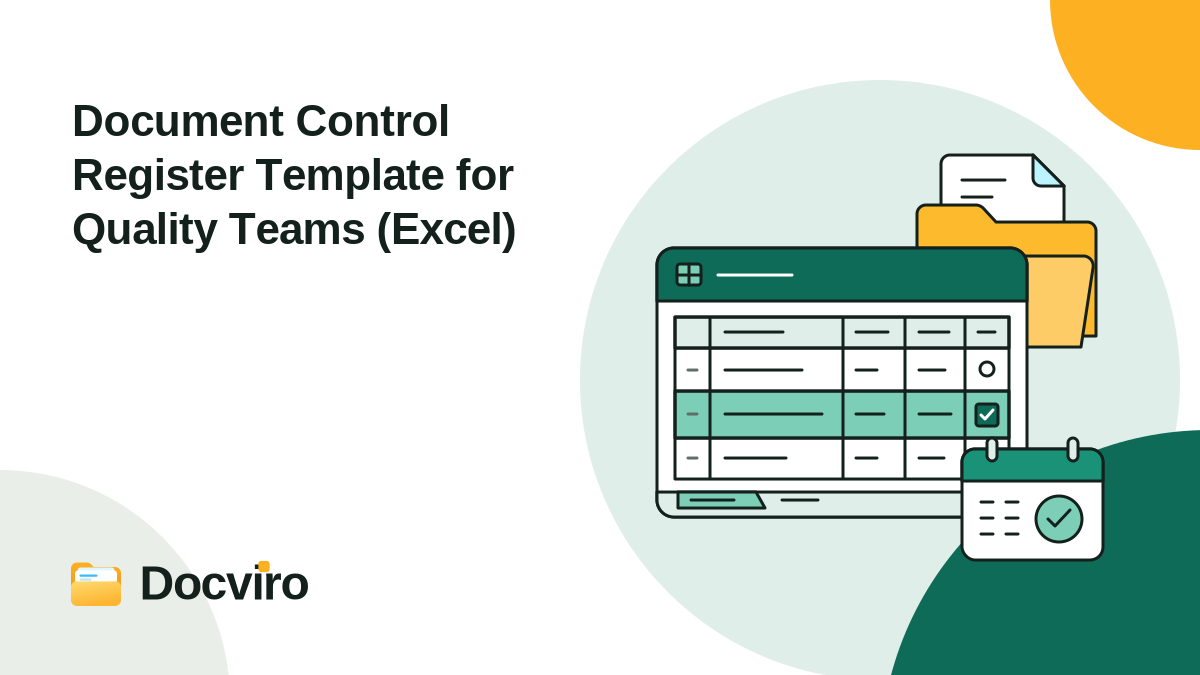
A document control register is one list of every controlled document in your quality management system. It is also called a master document list or document index. For each document it shows the ID, title, owner, current revision, status, approval and effective dates, and next review date. Its job is to let anyone (an auditor, a new hire, a supervisor on the shop floor) confirm in seconds which version is current, who approved it, and where the controlled copy lives.
This guide gives you a template you can build in Excel in about 15 minutes. It covers the exact columns, formulas for review dates and overdue flags, dropdown lists, and a companion change history sheet. Copy the column layout below into a blank workbook and you have a working register. After that, we cover how to keep it accurate, the mistakes auditors find most often, and the point where a spreadsheet register should hand over to a document management system.
## What a document control register does (and what ISO 9001 requires)
ISO 9001:2015 covers this in clause 7.5, Documented information. Clause 7.5.3 requires you to control documented information so that it is:
- Available and suitable for use where and when it is needed
- Adequately protected, for example against loss of confidentiality, improper use or loss of integrity
- Distributed, accessed, retrieved and used in a controlled way
- Stored and preserved, including preserving legibility
- Subject to control of changes, such as version control
- Retained and disposed of under defined rules
It also requires you to identify and control documents of external origin, such as customer specifications, standards and supplier data sheets.
The 2015 revision does not require a master list by name. The 2008 version required a documented procedure for document control, and many organizations kept the master list that came with it. Even so, a register remains the most common and easiest way to show an auditor that control is in place. Sector standards are often stricter. ISO 13485 (medical devices), for example, still requires a documented procedure for document control, including identifying changes and current revision status. For a broader walkthrough of the standard, see our [ISO 9001 document control guide](/blog/iso-9001-document-control-guide).
In practice, a good register answers five questions for every document:
1. What is it, and what is its unique ID?
2. Which revision is current, and is it in effect?
3. Who owns it and who approved it?
4. Where is the controlled copy, and who needs to know about changes?
5. When is it due for review?
## The document control register template: columns to include
Set up one row per document, not one row per revision. Revision history goes on a separate sheet (covered below). This keeps the main register short enough to scan.
| Column | Field | What to enter | Example |
|---|---|---|---|
| A | Doc ID | Unique, permanent identifier | QP-007 |
| B | Title | Plain-language title | Control of Nonconforming Product |
| C | Type | Dropdown: Manual, Policy, Procedure, Work Instruction, Form, Specification, External | Procedure |
| D | Process / Dept | Process or area that uses it | Production |
| E | Owner | Role or person responsible for content | Quality Manager |
| F | Revision | Current revision letter or number | C |
| G | Status | Dropdown: Draft, In Review, Effective, Obsolete | Effective |
| H | Approved by | Name and role of approver | J. Rivera, Ops Director |
| I | Approval date | Date the revision was approved | 2025-03-10 |
| J | Effective date | Date the revision took effect | 2025-03-17 |
| K | Last reviewed | Date of last review, with or without changes | 2025-03-10 |
| L | Review interval (months) | How often it must be reviewed | 24 |
| M | Next review due | Formula (see below) | 2027-03-10 |
| N | Review status | Formula: OK, Due in 30 days, Overdue | OK |
| O | Controlled copy location | Link or path to the single master file | Quality > Procedures > QP-007 |
| P | Distribution / training | Who must be notified or trained | Production leads, inspectors |
| Q | Last change ref | Change request or DCR number | DCR-2025-014 |
| R | Retention | How long obsolete revisions are kept | 10 years after superseded |
| S | Notes | Anything else an auditor might ask | Replaces old form F-12 |
If your team is small, you can drop columns P and R at first. Do not drop Status, Revision, Owner or Next review due. Those are the columns auditors test.
## Building the Excel version step by step
### 1. Create the workbook and sheets
Create three sheets: **Register**, **Change History** and **Lists**. Type the headers from the table above into row 1 of Register. Select the header row and your data area, press Ctrl+T, and confirm that the table has headers. Using an Excel Table means formulas, formatting and dropdowns extend automatically when you add rows.
On the Lists sheet, type your allowed values in separate columns: document types in one column, status values in another, and owners or departments in a third.
### 2. Add dropdowns with data validation
Select the Type column, then go to Data > Data Validation > Allow: List and point the source to the type list on the Lists sheet. Repeat for Status, and for Owner if you want consistent names. Dropdowns stop the slow drift into values like "effective", "Effective " and "Live" that break filters and formulas.
### 3. Add the review date formulas
In M2 (Next review due), enter:
`=IF(K2="","",EDATE(K2,L2))`
Format the column as a date. EDATE adds the review interval in months to the last review date.
In N2 (Review status), enter:
`=IF(G2<>"Effective","",IF(M2 Conditional Formatting > New Rule > Use a formula:
- Overdue: `=$N2="Overdue"` with a red fill
- Due soon: `=$N2="Due in 30 days"` with an amber fill
- Obsolete: `=$G2="Obsolete"` with gray text
The dollar sign before the column letter makes the whole row change color, not just one cell.
### 5. Lock it down
Use View > Freeze Panes on row 1 and column A so the ID and headers stay visible. Then protect the formula columns (M and N) under Review > Protect Sheet, leaving the data entry columns unlocked. Store the workbook in a location where only the document controller and quality manager can edit it, and everyone else can only view it.
## The change history sheet
The register shows the current state. The Change History sheet shows how you got there. Add one row every time a revision is approved:
| Doc ID | Revision | Change description | Reason | DCR # | Requested by | Approved by | Approval date | Effective date |
|---|---|---|---|---|---|---|---|---|
| QP-007 | C | Added quarantine tag step | Internal audit finding | DCR-2025-014 | Production lead | J. Rivera | 2025-03-10 | 2025-03-17 |
Keep this sheet append-only. Never overwrite or delete earlier rows. When an auditor asks why a procedure changed, this sheet answers the question without anyone digging through email.
## A document numbering scheme that scales
Decide on numbering before you populate the register, because changing IDs later breaks references across every document. A simple scheme looks like this:
- **Prefix for type:** QM (quality manual), QP (procedure), WI (work instruction), F (form), SPEC (specification), EXT (external)
- **Sequential number:** QP-001, QP-002, and so on
- **Revision separate from ID:** QP-007 Rev C, not QP-007C
Rules worth writing down:
- IDs are never reused, even after a document is made obsolete.
- The revision changes only when approved content changes. Typo fixes still count if the document is controlled.
- Forms carry their own ID and revision, separate from the procedure that references them.
- External documents get an EXT ID plus the issuer's own reference and edition, such as a customer drawing number and revision.
## How to keep the register accurate
A register is only useful if it matches reality. These habits keep it that way:
- **One person updates it.** Name a document controller and a backup. Everyone else submits changes through them or through a change request form.
- **Update the register in the same step as approval.** If approval and register updates happen on different days, they will drift apart.
- **Check it monthly.** Filter column N for Overdue and Due in 30 days, and send reminders to owners.
- **Spot-check the floor quarterly.** Pick five documents in use at workstations or in shared folders and compare their revisions with the register.
- **Retire, don't delete.** Set the status to Obsolete, move the old file to an archive location, and keep it for the retention period in column R.
## Common mistakes auditors find
These issues come up again and again in quality audits:
1. **Uncontrolled copies.** Printed or downloaded procedures at workstations that are older than the register shows.
2. **No evidence of approval.** The register says Rev C was approved, but there is no signature, email or record showing who approved it.
3. **Missing external documents.** Customer specifications and standards are used daily but are not on the register.
4. **Overdue reviews.** The review interval exists on paper, but nobody acted on it.
5. **Multiple "masters."** The same procedure exists in a shared drive, an email attachment and someone's desktop, each slightly different.
6. **Edits to the register without a trail.** Someone changed a status or date, and there is no way to tell who or when.
The last two are hard to fix in a spreadsheet, which leads to the next question.
## When a spreadsheet register stops working
An Excel register works well for a small QMS with one document controller and a few dozen documents. It starts to strain as the document count, the number of editors and audit expectations grow. The core problem is that the register and the documents live in different places, so they can disagree.
| Need | Excel register | Document management system |
|---|---|---|
| Single source of truth | Register points to files stored elsewhere | Register data and file are the same record |
| Revision history | Manual rows on a separate sheet | Every version saved automatically |
| Approval evidence | Separate email or paper signature | Approval recorded against the version |
| Who changed what | Limited, easy to overwrite | Audit log of views, edits and approvals |
| Access control | Folder and file permissions | Permissions per folder, often by role |
| Review reminders | Manual monthly filter | Can be handled by workflows or rules |
| Finding content inside documents | Only titles in the list | Full-text search, including scanned files with OCR |
Common signs it is time to move: you have more than one person editing the register, auditors ask for approval evidence you have to reconstruct, or you regularly find outdated copies in use. For a fuller look at how quality teams organize documents beyond the register, read our guide to [document management for manufacturing quality teams](/blog/document-management-for-manufacturing-quality-teams).
## How Docviro handles document control
Docviro is a cloud document management platform, so the register and the controlled documents live in the same place rather than in two systems you have to reconcile.
- **Version history:** each time a document is updated, Docviro keeps the previous versions, so the current revision and its predecessors are always linked. See [version control](/features/version-control).
- **Folders with permissions:** you can let the document controller edit the Procedures folder while production staff have view-only access, which reduces the risk of uncontrolled edits.
- **Approval workflows:** route a draft to reviewers and approvers in a set order before it becomes effective. See [workflow automation](/features/workflow-automation).
- **Electronic signatures:** approvers can sign, and each signed document comes with a certificate of completion and a public verification page, which gives auditors approval evidence tied to the document.
- **Audit logs:** views, edits and approvals are logged, which covers the who-changed-what question a spreadsheet struggles with.
- **Metadata and search:** fields such as document ID, owner and review interval can be stored as metadata, and AI metadata extraction can help populate them from existing files. Full-text search with OCR also finds content inside scanned legacy procedures.
- **Retention rules:** obsolete revisions can be kept for a defined period instead of being deleted by hand.
- **Secure sharing:** when a supplier or customer needs a specification, you can share it with an expiring link rather than emailing an attachment that becomes an uncontrolled copy.
Many teams keep their Excel register during the move, use it to set up folders and metadata, and then retire it once the documents and their history are in Docviro.
## FAQ
### Is a document control register mandatory for ISO 9001?
ISO 9001:2015 does not require a register by name. It requires you to control documented information, including identification, approval, version control, distribution and retention. A register is the simplest way to demonstrate that, which is why most auditors expect to see one or an equivalent view in a document management system.
### What is the difference between a document control register and a records register?
A document control register tracks documents that tell people how to work, such as procedures, work instructions and forms, which are revised over time. A records register tracks evidence that work was done, such as completed inspection forms, calibration certificates and training records, which should not be changed once created. Many teams keep both, with different retention rules.
### How often should controlled documents be reviewed?
The standard does not set a fixed interval, so you decide based on risk and how often the process changes. Many quality teams use 12 to 36 months, with shorter intervals for high-risk or fast-changing processes. Whatever you choose, record it in the register and be able to show reviews actually happened.
### Should external documents go on the register?
Yes. ISO 9001 requires documented information of external origin that you need for your QMS to be identified and controlled. Add customer specifications, standards and key supplier documents with an EXT ID, the issuer's reference and edition, and a named owner who checks for updates.
### Can I keep using Excel if I move to a document management system?
You can, but running both long term recreates the problem of two sources that can disagree. A common approach is to use the spreadsheet to plan the migration, map its columns to metadata fields, and then treat the document management system as the master. Exported reports from the system can replace the spreadsheet when someone needs a list.
Ready to organize your documents?
Manage files, metadata, approvals, retention policies, and AI-powered document intelligence with Docviro.